
Life Practice · Orientation
Every time our immediate environment changes, we can reset our intentions to keep them in line with our overall sense of purpose. But this always takes fresh insight.
Illustration · 4:3
Same image as this function’s hub panel
Local Alignment · stones and paths: arranging, orienting
For a person to be fully-functional w.r.t. aiming, they must consistently make choices of what activities to engage in that, if they ever look back, they’ll be proud to have made.
Life has many rhythms. Trees grow and shed their leaves as the annual cycle of the seasons tips towards winter. Every morning, as daylight arrives, birds wake and sing out their territorial claims. When any creature walks, there’s a tempo to the pushing of its feet against the ground.
There’s also a rhythm that arises from creatures engaging in one activity and then another. They begin an activity, continue it till either they’ve gained the benefits it offered, or till it’s interrupted by the arrival of something more pressing. Then they bring the activity to an end and choose something new to do.
One activity, then another. Starting, doing, ending, choosing, and starting again. All animals with complex brains have this rhythm in their life.
We can see this as a cycle.
At the top of the cycle, the creature makes a choice about what they’ll do next. During the rest of the cycle, they carry out their chosen activity.
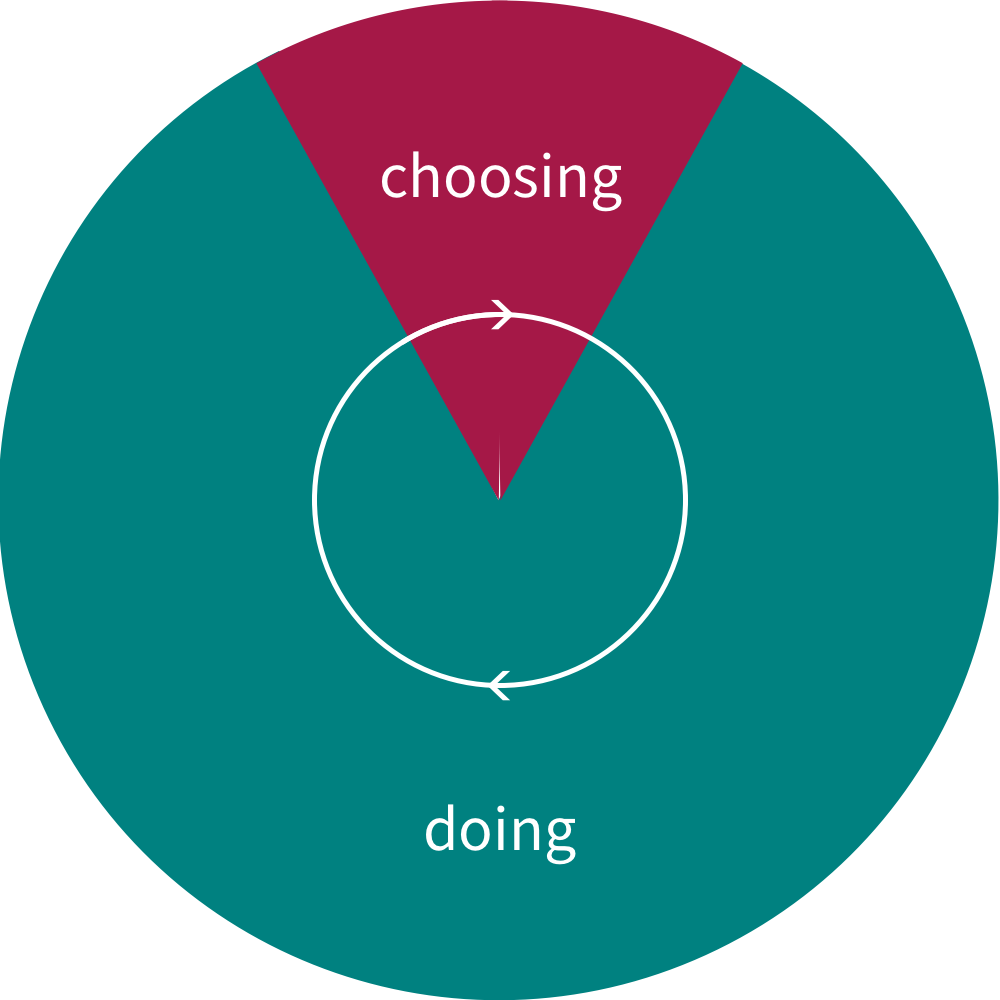
Most creatures rely on their instincts to guide them through these cycles of activity. They’ll quite naturally choose the activities most needed for their flourishing. Natural selection took care of it.
Being human, though, we tend to put our faith in ideas. We pause and think. Make new mental maps of what’s going on around us. We sometimes remind ourselves of our priorities and plans. And all in a flash, sometimes.
Once we’ve had these flashes, taking aim becomes easy. We’ve seen the scene as a whole. We have a sense of what we hope to make happen. It’s usually obvious enough how to start going about things.
There’s one network of brain areas needed for choosing and planning. And different networks of brain areas are needed for the actual doing.
If an activity is challenging, we’ll only perform if we immerse ourselves fully in the activity’s game. We have to sustain our attention on the concrete details of the field of play in front of us. Any extraneous thoughts would interfere with the flow of perception and action.
But to make informed choices of what activity to do next, we need to extract our attention from the concrete details and consider the bigger picture. Our minds need to contemplate our tactical and strategic ambitions. We need to size up the options available.
We can think of the parts of mind that maintain our performance within an activity as the inner actor. It weaves together lines of effective action. The parts of mind that choose what to do and plan make up the inner director.
The inner actor and inner director represent incompatible patterns of mental activity. They vie for dominance.
When the inner director is dominant, we’re able to take a wide range of factors into account as we choose activities, or we think ahead. When the inner actor takes over, the inner director pulls back, making space for all the mental activity that will have to happen for the person to perform well in the activity. There’s a cost. The person becomes blind to context. But the gain is enormous. They weave desirable possibilities together through action. Performing well can be thrilling. There’s always a thread to follow. It can be a thin thread. Or a thread that we can lose.
We’re at our best when our mental rhythms are in sync with our rhythms of activity. We want our inner directors dominant during the choosing phases of the activity cycle and our inner actors taking over the rest of the time.
We’re at our best when our mental rhythms are in sync with the rhythms of our actions, with our inner directors dominant during the choosing phases of the activity cycle and our inner actors regaining dominance for the doing phases.
Coachwise
Find tools to help you with your aiming.